
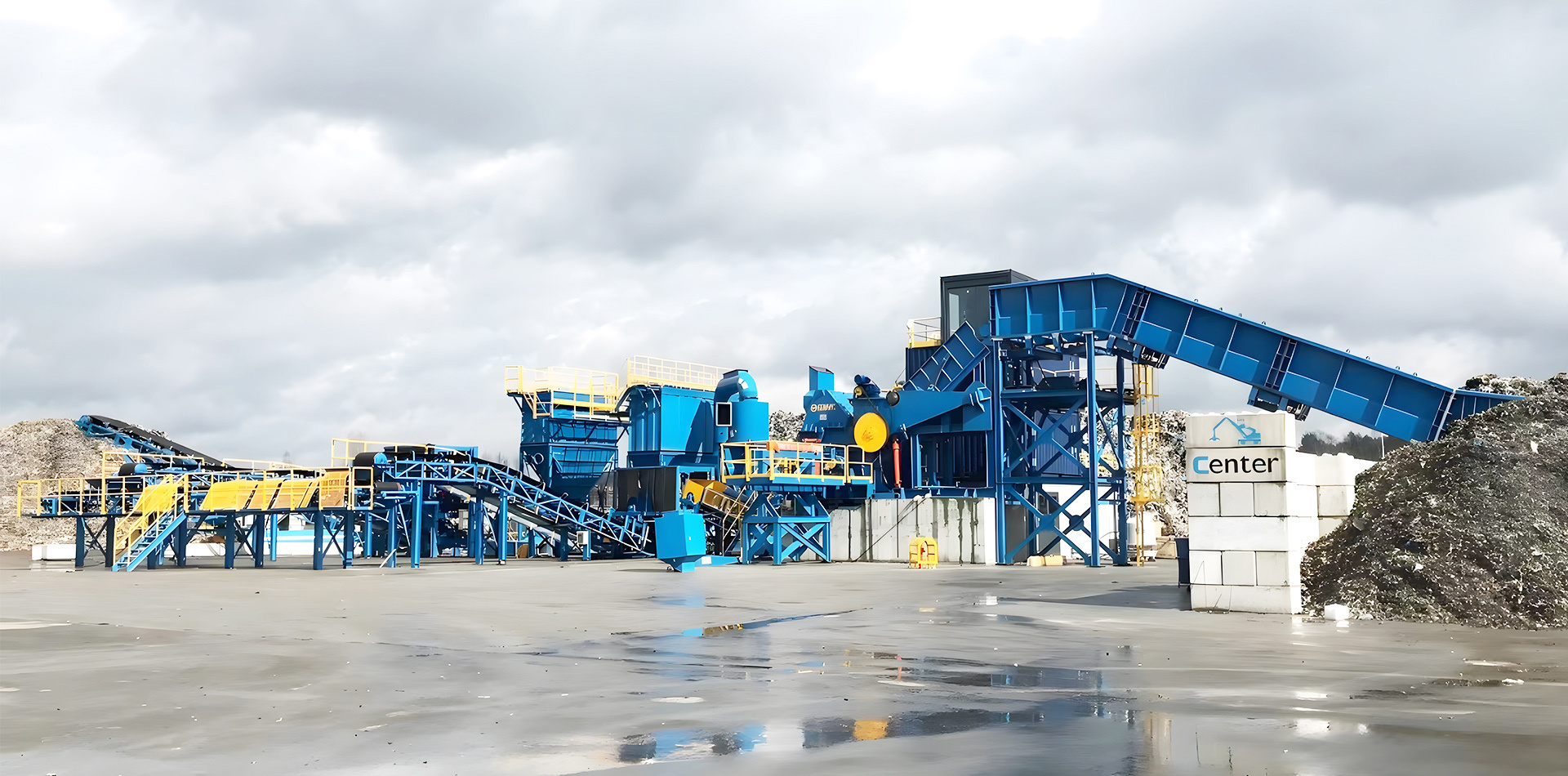

Poland | Mixed Scrap Shredding and Sorting Line
Category:
Metal Recycling Plants
ELV & Mixed Scrap Metal Recycling Plant
Metal Shredding Systems
Double Shaft Shredder
Shredder
Size Classification Systems
Metal Separation Systems
X-Ray Sorter
Eddy Current Sorter
Auxiliary Equipment & Systems
For operators building a mixed scrap processing facility, one of the most common mistakes is to treat the project as a question of buying a stronger shredder.
In real projects, the throughput capability of the main shredder matters. But it only solves part of the problem.
- If light material is not removed early, magnetic separation becomes contaminated and trommel screens are more likely to blind or block.
- If ferrous material is not removed cleanly in advance, it can damage the eddy current separator and shorten its service life..
- If the particle size range is too wide, both eddy current separation and XRT sorting become less predictable.
This Polish project is a good example. The customer needed to process ELV scrap, white goods and other mixed scrap metals in the same facility. The material composition was highly variable, with metals mixed together and contaminated by plastics, leather, textiles, paint and other attached materials. To turn this feed into higher-value products, the line had to shred, liberate, clean, size and sort the material through a coordinated process.
For SIMVIC, the first step was to understand what the customer wanted to recover. Only then could the material condition be reorganized properly.
The customer needed clearly defined output fractions
This type of project should not start with an equipment list. We usually begin with three questions:
- Which fractions does the customer need to sell?
- What are the size and purity targets for each fraction?
- Which contaminants will disturb downstream separation first?
The answers directly affect both the process route and the equipment selection.
In this case, the customer’s target was clear: recover ferrous material, produce Zorba in two size fractions, 10-30 mm and 30-80 mm, and further recover high-value heavy non-ferrous metals downstream.
If the line only focuses on shredding, the mixed scrap becomes smaller, but it remains mixed. For the plant owner, the real value depends on whether downstream sorting can turn the material into products that buyers can identify, price and receive consistently.
To achieve this target, SIMVIC organized the Polish line with the following process sequence:
Mixed scrap feed
-> Twin-shaft shredder: pre-shredding
-> PSX-5070 hammer shredder: main shredding and liberation
-> First air separation: removal of light material
-> Magnetic drum: ferrous recovery
-> First trommel screening: removal of fines and oversize
-> Oversize return for re-shredding
-> Second air separation: further light material separation
-> Second trommel screening: size classification
-> Eddy current separation: Zorba recovery
-> XRT sorting: recovery of high-value heavy non-ferrous metals
The line has several stages, but the process logic is straightforward: each module should receive material in a condition it can handle well.
The twin-shaft shredder prepares a stable feed for the PSX-5070
The PSX-5070 hammer shredder is the main processing unit in this line, with a design capacity of up to 15 TPH. This capacity is suitable for the main shredding and liberation duty.
At the main shredding stage, stable discharge is critical. Particle size, flow continuity, instantaneous load and ferrous liberation all affect the downstream process.
That is why SIMVIC placed a twin-shaft shredder before the main shredder. The pre-shredding stage prepares a more stable material flow for the PSX-5070, allowing the main shredding section to operate under better feed conditions.
The final recovery performance, however, still depends on whether the downstream system can receive and process the material properly.
The two air separation stages deal with different material conditions
The first air separation stage is installed after the main shredder. This is a common arrangement in European mixed scrap processing lines.
At this point, the material leaving the main shredder has just been opened up. It still contains foam, textiles, plastic film, paper, dust and fiber-like light material. If these materials enter the next stages directly, they can wrap around the magnetic drum, cover metal surfaces, disturb screening and cause screen blinding or blockages.
The main purpose of this first air separation stage is system unloading.
It removes light material that would otherwise create problems through magnetic separation, screening, eddy current separation and XRT sorting.
The second air separation stage is placed after magnetic separation and the first trommel, before the secondary trommel screen. By this point, ferrous material has been recovered, fines have been removed and oversize has been returned. The remaining material has a narrower particle size range and a more stable bulk density. Light material that was previously attached to metal pieces can also be further released through conveying, tumbling and screening.
At this stage, air separation is working on a conditioned material stream with freer light fractions. The separation behavior is more controllable, and the air separation efficiency is usually higher than in the first stage.
After the second air separation removes the remaining light material, it helps improve size classification accuracy in the trommel screen, reduce the load on the eddy current separator and lower the risk of mis-sorting in the XRT system.
Based on SIMVIC’s field experience, one operating point must be watched carefully: air volume should not be set too high. If the second air separation stage is too aggressive, small aluminium pieces, copper granules and thin stainless steel can be carried away with the light fraction. This stage should be treated more like density adjustment than simple light waste removal. During commissioning, air volume, feed depth, moisture content and metal loss in the light fraction should be tracked together.
Screening determines whether Zorba quality stays stable
The first trommel screen removes fines below 10 mm and returns oversize above 80 mm to the shredder for reprocessing. This closed loop reduces the impact of large pieces entering the downstream sorting section.
The second trommel then separates the remaining non-ferrous stream into two size fractions: 10-30 mm and 30-80 mm. This step may look simple, but it defines the working window for the eddy current separator.
Eddy current separation is sensitive to particle size and bed depth. If the size range is too wide, small pieces can be hidden by larger material. If too much light material remains, the discharge trajectory becomes unstable. If ferrous carryover is too high, equipment risk also increases. The sequence of magnetic separation, screening and secondary air separation is designed to give the eddy current separator a cleaner and more consistent feed.
XRT belongs after the material has been conditioned
In mature mixed metal recycling lines around the world, XRT sorting is commonly used to further separate heavy non-ferrous metals from the non-ferrous stream. These high-value heavy metals can become a major source of profit for the full line.
If fluff, fines, ferrous carryover and oversize pieces have not been removed first, sensor sorting faces too much noise. XRT is best used as a downstream refining stage, not as a way to compensate for a chaotic front-end material stream.
This is why the XRT sorter in this project is positioned after shredding, air separation, magnetic separation, screening and ECS. At that point, the material has already gone through several conditioning steps, making heavy metal recovery more stable.
Final output: saleable products with stable quality
The target outputs of this project include:
- Ferrous material
- Zorba 10-30 mm
- Zorba 30-80 mm
- High-value heavy non-ferrous metals
Under stable feed conditions, correct equipment settings and proper maintenance, the purity and recovery rate of the main products can reach above 98%.
That figure should not be promised without considering the feed composition. The proportion of ELV scrap and white goods, the level of plastics and rubber, moisture content, pre-shredding performance and operator settings all affect the final result.
The value of the product depends on metal purity and fraction stability. Buyers care more about batch consistency than a single good sample.
For this reason, the more practical engineering goal is controlled product quality: cleaner ferrous output, clearly sized Zorba fractions and heavy non-ferrous products with further sales or refining value.
SIMVIC’s full-line engineering capability
For this Polish line, SIMVIC designed the process around the target outputs from the beginning. Based on the feed characteristics and material variation, SIMVIC integrated pre-shredding, main shredding, air separation, magnetic separation, screening, eddy current separation and XRT sorting into one coordinated production line.
For operators, a clear process route makes the material flow easier to observe and adjust. It also makes abnormal conditions easier to locate. Clear size classification and product routing also leave room for further downstream refining in the future.
Based on SIMVIC’s experience in full plant engineering, the first question in similar projects should not simply be: “How many TPH can the main shredder process?” Plant owners should ask more practical questions:
Which contaminants in my feed will disturb downstream sorting first?
Are my target products ferrous, Zorba and heavy metals, or do they need further separation?
Which modules must be installed in phase one, and which interfaces should be reserved for phase two?
Once these questions are clear, the equipment combination and process route become much easier to define.
For scrap yards processing ELV scrap, white goods and mixed scrap metals, a powerful single machine does not automatically create a strong full line. A well-designed shredding and sorting line applies the right process at the right position: unload the system, classify the material, refine the fractions and guide metals of different values to the right outlets.
This is the engineering logic behind SIMVIC’s Polish project.
READ MORE
Contact Our Engineers
Get an Integrated Plant Solution
Request Technical Information
Provide material type, capacity, and project details to receive a tailored solution.